How a cyberattack disrupted one of the world’s largest medical device companies and the cybersecurity lessons every organization should understand
Cybersecurity incidents often feel distant until they hit a company whose products are used every day. That happened this week when Stryker Corporation, one of the world’s largest medical device manufacturers, experienced a cyberattack that disrupted systems across its global network.
For many business owners the immediate reaction is often something like, “That’s a huge company. They are the target. We are not.” The reality is different. The lessons from incidents like this apply just as much to small and mid sized organizations as they do to global enterprises.
Understanding what happened and why it matters can help organizations strengthen their defenses before the next attack occurs.
Quick Summary of the Stryker Cyberattack
A cyberattack disrupted global systems at Stryker Corporation, one of the largest medical device manufacturers in the world. Employees reportedly lost access to internal applications and some corporate devices were remotely wiped. The group Handala claimed responsibility for the attack, although investigations into attribution are ongoing. The incident highlights how modern cyberattacks increasingly target identity systems and enterprise infrastructure rather than just individual computers.
What Happened
Reports indicate that Stryker experienced a cyberattack that disrupted internal systems worldwide. Employees reportedly lost access to key corporate services including email and internal applications, and some company devices were remotely wiped.
Early information suggests the attack may have targeted identity systems tied to Microsoft infrastructure. If attackers gain access to identity platforms, they can potentially take control of endpoints and administrative tools across an entire environment.
Unlike many cyber incidents we see today, this attack may not have been primarily about financial gain. Instead, early reporting suggests the goal may have been disruption.
Why This Attack Is Significant
Stryker is not just another technology company. It manufactures medical equipment and surgical technology used by hospitals and healthcare providers around the world.
When a company like this experiences a cyberattack, the potential impact extends far beyond their internal operations. It can affect supply chains, healthcare providers, and medical services globally.
From a cybersecurity perspective, three things stand out.
Identity Systems Are Now a Primary Target
Modern cyberattacks increasingly focus on identity platforms such as Microsoft Entra ID or Active Directory rather than traditional malware infections.
If attackers gain administrative control of identity systems they can:
- Reset passwords
- Disable user accounts
- Wipe or lock devices
- Push malicious policies
- Lock administrators out of their own systems
In many ways, controlling identity infrastructure means controlling the entire network.
Destructive Cyberattacks Are Increasing
Many cyber incidents today involve ransomware, where attackers encrypt systems and demand payment.
In this case, early reports suggest devices were remotely wiped. This type of attack is often referred to as a destructive or wiper attack.
These attacks are often associated with politically motivated cyber operations where the goal is disruption rather than financial gain.
Supply Chain Risk
When a large manufacturer experiences a disruption, the impact extends far beyond its offices.
Hospitals, distributors, and healthcare providers depend on companies like Stryker for critical equipment and technology. If production or logistics are affected, it can create operational challenges across the healthcare ecosystem.
This is one of the reasons cybersecurity is now considered a business continuity issue rather than just an IT concern.
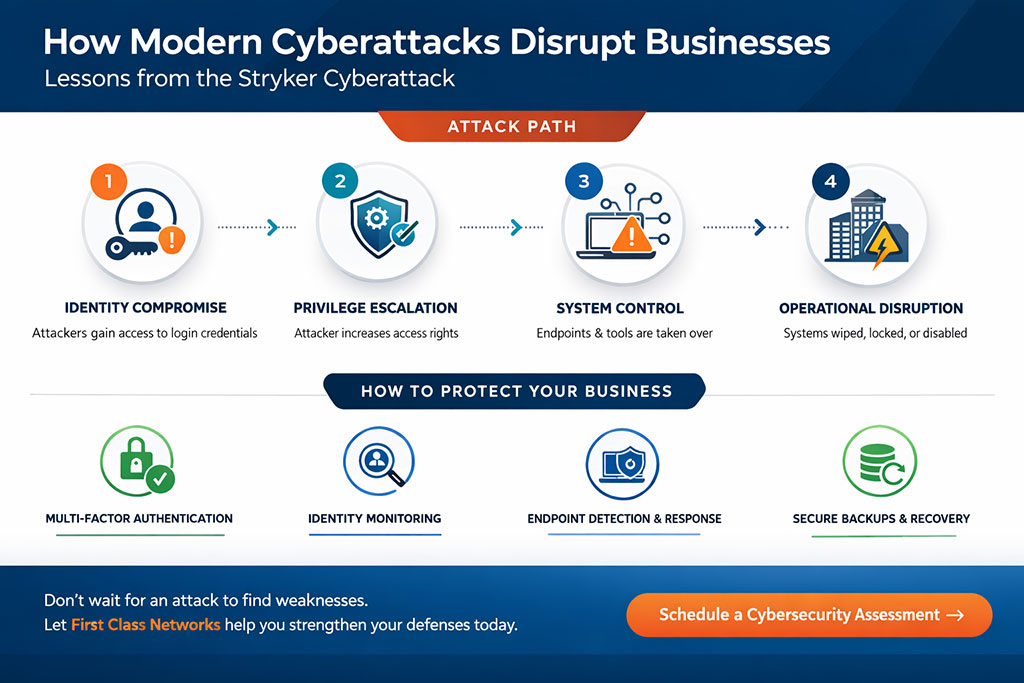
How Modern Cyberattacks Disrupt Businesses
Most modern cyberattacks follow a predictable pattern. Understanding this progression helps businesses recognize where to strengthen their defenses.
- Step 1: Identity Compromise
Attackers gain access to login credentials or identity systems such as Microsoft Entra ID. - Step 2: Privilege Escalation
The attacker increases access rights and moves deeper into the network. - Step 3: System Control
Endpoint management tools, servers, or cloud infrastructure are taken over. - Step 4: Operational Disruption
Systems are wiped, locked, or disabled, causing business interruption.
Businesses can significantly reduce risk by protecting identity systems, monitoring endpoints, and maintaining secure backups.
What This Means for Small and Mid Sized Businesses
A common misconception among business owners is that smaller companies are not attractive targets for cybercriminals.
In reality, attackers often look for the easiest entry point. Smaller organizations frequently become stepping stones into larger supply chains.
If attackers can compromise a vendor, partner, or service provider, they may gain indirect access to larger organizations.
That is why every business today needs to treat cybersecurity as a fundamental part of running the business.
What Businesses Should Do Right Now
Incidents like the Stryker cyberattack are reminders that cybersecurity must be proactive rather than reactive.
Businesses should take several practical steps to reduce their risk.
- Enable multi factor authentication everywhere
Multi factor authentication significantly reduces the risk of identity compromise. - Secure identity platforms
Platforms such as Microsoft Entra ID and Active Directory are now primary attack targets and must be monitored carefully. - Deploy endpoint detection and response tools
Modern endpoint protection helps detect suspicious activity that traditional antivirus often misses. - Maintain secure and tested backups
Backups should be isolated, protected, and regularly tested. - Develop an incident response plan
Every organization should know exactly what steps to take if systems suddenly become unavailable due to a cyberattack.
Preparing in advance can make the difference between a temporary disruption and a major business crisis.
How First Class Networks Helps Businesses Prevent Attacks Like This
Cyber incidents like the Stryker attack demonstrate how quickly a company’s operations can be disrupted when attackers gain access to identity systems or critical infrastructure.
First Class Networks helps organizations reduce risk through proactive cybersecurity strategies that include:
- Identity and access security assessments
- Endpoint detection and response monitoring
- Secure backup and disaster recovery solutions
- Continuous security monitoring and threat detection
- Cybersecurity awareness training for employees
If you are unsure whether your organization is protected against modern cyber threats, our team can help evaluate your current defenses and identify potential vulnerabilities.
Contact First Class Networks today to schedule a cybersecurity assessment and learn how to strengthen your organization’s defenses before an incident occurs.
Final Thoughts
Cyber threats continue to evolve quickly. What once seemed like a risk only for large enterprises now affects organizations of every size.
Incidents like the Stryker cyberattack serve as reminders that cybersecurity is not just an IT issue. It is a business continuity issue.
Organizations that invest in strong cybersecurity controls today are far more likely to continue operating smoothly when the unexpected happens.
Every business has something worth protecting. The question is whether the right safeguards are in place before an incident occurs.
Frequently Asked Questions
What happened in the Stryker cyberattack
Stryker experienced a cyberattack that disrupted internal systems across its global network. Employees reportedly lost access to email, internal applications, and some corporate devices.
Who was responsible for the attack
The hacktivist group Handala claimed responsibility for the attack, although investigations into attribution are ongoing.
Was ransomware used in the attack
Early reports suggest the attack may have involved destructive actions such as wiping systems rather than encrypting them for ransom.
Why would attackers target a medical device company
Medical device manufacturers are part of the global healthcare supply chain. Disrupting their systems can affect hospitals, equipment distribution, and healthcare operations.
Why should small businesses care about this attack
Cyber attackers often target supply chains and vendors. Smaller businesses can become entry points into larger networks if they are not properly secured.