Tax season is here.
Your accountant is busy. Your bookkeeper is gathering documents. W-2s and 1099s are flying around. Deadlines are approaching.
But here is what most small businesses do not prepare for:
The first tax season problem is often not a tax issue. It is a cybersecurity issue.
And the most common early-season threat is the W-2 email scam.
This scam targets small and mid-sized businesses every February and March. It looks legitimate. It feels urgent. And it can expose every employee’s personal information in minutes.
If you run a business with payroll, this applies to you.
What Is the W-2 Email Scam?
The W-2 scam is a type of phishing attack that targets payroll, HR, and finance staff.
Here is how it works:
Someone in your company receives an email that appears to be from the CEO, owner, or senior executive.
The message is short and urgent:
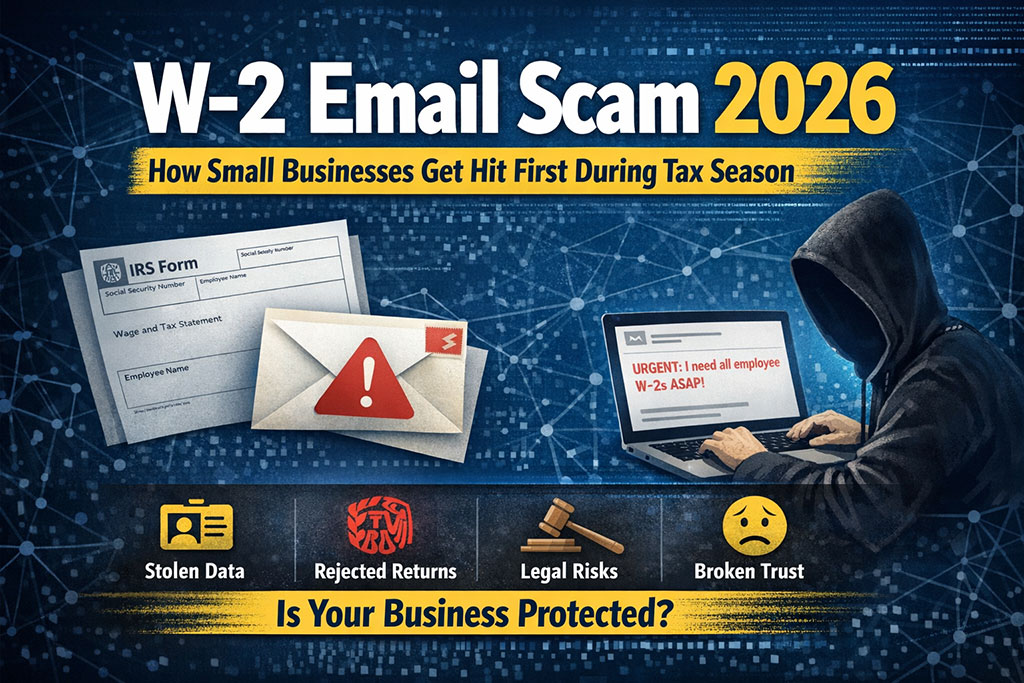
“Can you send me copies of all employee W-2s for a meeting with the accountant? I need them ASAP.”
The tone sounds right. The timing makes sense. It is tax season, after all.
So the employee sends the W-2s.
Except the email was not from the CEO. It was sent by a criminal using a spoofed email address or a look-alike domain.
Within minutes, the attacker now has:
- Full legal names
- Social Security numbers
- Home addresses
- Salary information
In other words, everything needed for identity theft and fraudulent tax filings.
What Happens After a W-2 Scam?
Most companies do not realize what happened until employees start filing their tax returns.
Then they hear this:
“Your return has been rejected. A return has already been filed under this Social Security number.”
A criminal has already submitted a fraudulent return and claimed the refund.
Now your employee is dealing with:
- IRS identity theft reports
- Delayed refunds
- Credit monitoring
- Months of paperwork
Multiply that by your entire payroll.
This is not just a data breach. It becomes:
- An HR crisis
- A trust issue with your team
- Potential legal exposure
- A serious reputational problem
For small businesses, the impact can be significant.
Why the W-2 Scam Works So Well
This is not an obvious scam. It is carefully timed and psychologically engineered.
Here is why it succeeds:
- Perfect Timing
W-2 requests are normal in February and March. No one questions the context. - Reasonable Request
Unlike wire transfer fraud, this request does not feel extreme. Sharing payroll documents during tax season seems ordinary. - Urgency Feels Natural
“Can you send this quick?” does not trigger alarm bells in a busy office. - Research-Based Targeting
Attackers often know the CEO’s name. Sometimes they know your accountant’s name. They make the message believable. - Employees Want to Be Helpful
When a request appears to come from leadership, people respond quickly. Urgency overrides verification.
That combination makes the W-2 scam one of the most effective small business phishing attacks every year.
How to Prevent the W-2 Email Scam
The good news is that this attack is preventable.
Protection requires policy, process, and basic cybersecurity controls.
- Create a No W-2 via Email Policy
W-2s and payroll documents should never be sent as email attachments. No exceptions. If someone requests them by email, the answer is no. - Verify Sensitive Requests in a Second Channel
If leadership requests payroll data, confirm it through a phone call or in-person conversation. Use a trusted contact method already on file, not information provided in the email. - Hold a Short Tax Season Security Meeting
Take 10 minutes and brief payroll and HR staff. Explain what these scams look like and what to do. Awareness dramatically reduces risk. - Enable Multi-Factor Authentication on Payroll and HR Systems
If employee credentials are compromised, multi-factor authentication can stop attackers from accessing sensitive systems. - Reward Verification
Employees who double-check unusual requests should be supported and praised. A culture that encourages verification prevents costly mistakes.
These steps can be implemented this week and dramatically reduce risk.
Other Tax Season Cybersecurity Threats to Watch
The W-2 scam is only the beginning.
During tax season, businesses commonly see:
- Fake IRS payment demand emails
- Phishing messages disguised as tax software updates
- Spoofed emails from “your accountant”
- Fraudulent invoices that appear tax-related
Cybercriminals exploit distraction and urgency. Tax season creates both.
Businesses that move through tax season without incident are not lucky. They are prepared.
Is Your Small Business Protected?
Ask yourself:
- Are W-2 and payroll document policies clearly defined?
- Is multi-factor authentication enabled on payroll systems?
- Does your team know how to spot executive impersonation emails?
- Do you have email protections that detect spoofing attempts?
If you cannot confidently answer yes, now is the time to address it.
Tax season is stressful enough. Identity theft and a payroll data breach make it exponentially worse.
If you would like a quick review of your payroll security controls, we can walk through:
- Payroll and HR system access controls
- Multi-factor authentication setup
- Email spoofing protections
- Verification policies for sensitive requests
A short conversation now can prevent months of cleanup later.
Because the W-2 scam does not wait until April.
It starts now.